VINTAGE GT
GT BICYCLES

VINTAGE GT
GT BICYCLES
GT Bicycles has been around for a long time. It was founded back in 1972. This established company loves to hire graduates from Bates College, with 14.3% of its employees having attended Bates College. GT Bicycles is a great place to work and is featured as number 15 on Zippia’s list of Best Companies to Work for in Wilton, CT.
VINTAGE GT
GT BICYCLES TIMELINE
1974: The Beginning of GT Bicycles
Richard Long’s life changes dramatically after suffering a severe motorcycle accident. His femur is shattered, leading to an extended hospitalisation. During this period, Long reflects on his future, becoming determined to forge a new path for himself.

Post-Accident Recovery: As he recovers, Long’s entrepreneurial spirit grows. He sets his sights on starting his own business, using his accident as the catalyst for this life-changing decision.
Insurance Settlement: Long receives a $14,000 settlement from his motorcycle accident insurance. Instead of using it for personal expenses or luxuries, Long decides to invest the entire sum into a business venture.
Business Decision: After researching several industries, Long chooses to purchase a Columbia Bicycles franchise with the settlement. This move is bold, given that Long has no prior experience in the bicycle industry, yet it marks the start of his journey into the cycling world.
Turner’s First BMX Bike: Turner begins experimenting with a $5 bike from the Salvation Army for his son, Craig. He modifies the bike to make it more suitable for BMX-style riding, raising the bottom bracket and stripping away unnecessary parts. These early modifications showcase Turner’s ingenuity and hands-on approach to problem-solving.
Early 1974: Meanwhile, Gary Turner, already a seasoned welder and motorcycle frame builder, stumbles upon BMX while attending a motorcycle race. He spots young boys racing bicycles on dirt tracks and is immediately intrigued by the burgeoning sport.
BMX Growth: The modified bike gains attention from other kids and parents at the BMX dirt lot in Long Beach. Turner’s interest in BMX deepens as he recognizes the potential to improve the design and performance of these bikes.
BMX Explosion: The popularity of BMX begins to explode in Southern California, with more tracks being built and events regularly held. Turner starts taking Craig to BMX events at the Western Sports-Arama (WSA) track in Orange, CA.
1975: Turner’s First Major BMX Innovation
Gary Turner realises that merely modifying existing bikes will not suffice for the growing demands of BMX riders. To create a bike that is truly competitive, Turner opts to build a new BMX bike entirely from lightweight chromoly steel, a high-quality material known for its strength and light weight.
Turner’s second-generation BMX bike design is not only lighter but also more durable than anything else on the market. This marks a significant step in BMX bike development, as other manufacturers at the time were still using heavier materials like mild steel.
Turner’s Reputation Grows: The new design quickly gains attention from BMX racers and their parents. The bike’s superior handling and lightweight frame become widely recognised, establishing Turner as a serious player in the BMX community. He starts to receive more and more requests for custom frames.
1976: Team Gary Turner and Early Frame Production
BMX’s popularity skyrockets, especially in Southern California. More than 100 tracks are in operation by the end of the year, and the sport becomes a phenomenon among young riders.
Gary Turner begins producing BMX frames for his brother Glenn, and soon after, builds frames for his son Craig. These custom frames are lighter, stronger, and better designed for the high-impact nature of BMX racing.
After building frames for both Glenn and Craig, Turner forms “Team Gary Turner” to compete in BMX races. The team’s presence at local BMX events garners attention, further raising the profile of Turner’s frames.
1977: Richard Long Enters the Picture
1974 THE BEGINNING. Richard Long owns and runs a bike shop in Orange County, California. He notices Gary Turner and his frames. He notices that they are selling and that people want to know how to get them. Richard calls Gary and asks him if he can stock and sell the frames. Gary agrees and the most famous partnership in BMX history starts.
1978: GT’s Factory Team and Early Recognition
From a small garage in Fullerton in California, Gary Turner teamed up with Richard Long, BMX racetrack operator. Together, they started GT Bicycles in 1977. Named after Turner’s own initials, the company specialised in BMX bikes. Their sales surged right away, reaching $4 million by the end of 1981.
1979: The Rise of GT Bicycles
GT Bicycles was founded in 1979 by BMX racetrack operator Richard Long and engineer and former drag racer Gary Turner, who had been building customized bicycle frames in his garage in Santa Ana, California; the finished bikes were ridden by Turner’s son in area races. Named GT after Turner’s initials, the company was created to manufacture BMX bikes for boys. Their first products were chrome-moly steel frames, which made a bicycle light and sturdy, and designed to enhance performance. By 1981, from a single bicycle shop in Anaheim, the company was selling complete BMX bicycles, and sales reached $4 million, with gross margins of nearly 70 percent due to the low overhead of manufacturing in Turner’s garage.
1980: Scaling Up Production
1980-86 THE GLORY DAYS OF BMX. GT expands exponentially every year and enters the new off shoot sport of BMX, Freestyle. The first frame designed by Gary for freestyle, the Performer, becomes a legend in freestyle and, still today, in 2002, is one of the most recognized brand names in juvenile bicycles. The company moves into new digs on 2300 Container Lane in Huntington Beach California. Soon, they grow from one office into 4 separate buildings that handle welding, warehousing, shipping and administrative. During this period GT would come to dominate BMX racing as the sport matured into a worldwide phenomena. GT establishes itself as the preeminent racing brand in the sport and begins to dominate the race venues that would lead to the nickname “the firm”. For better or for worse GT goes from garage to corporate in a big way.
In 1980, GT Bicycles launched its first bike called the GT Pro. They also started sponsoring BMX racers which included the likes of Denny Davidow and Lee Medlin. On the same year, GT had its first magazine ad published on Bicycle Motocross Action.
1981: Further Expansion and Brand Building
GT Bicycles was founded in 1979 by BMX racetrack operator Richard Long and engineer and former drag racer Gary Turner, who had been building customized bicycle frames in his garage in Santa Ana, California; the finished bikes were ridden by Turner’s son in area races. Named GT after Turner’s initials, the company was created to manufacture BMX bikes for boys. Their first products were chrome-moly steel frames, which made a bicycle light and sturdy, and designed to enhance performance. By 1981, from a single bicycle shop in Anaheim, the company was selling complete BMX bicycles, and sales reached $4 million, with gross margins of nearly 70 percent due to the low overhead of manufacturing in Turner’s garage.
1982: Greg Hill and GT’s Success
In 1984, the company entered the fast-growing (and higher-priced than BMX) mountain bike industry, introducing its own line of mountain bicycles and going head-on against segment leader Cannondale, then a Pennsylvania-based manufacturer led by Joseph Montgomery.
1983: Dyno and GT’s Freestyle Entry
In 1985, GT acquired Dyno from Bob Morales along with its apparel and footwear collection.
1984: Success in Freestyle BMX
The company acquired Riteway Distributor in 1987 and then proceeded to purchase three more distributors in the United States, to help market its products in the nearly $3 billion parts and accessories market.
1985: Freestyle Dominance
1988: Full assortment of USA made 4130 BMX and freestyle frames, components and accessories
1986: Entry into Mountain Biking
The company acquired Riteway Distributor in 1987 and then proceeded to purchase three more distributors in the United States, to help market its products in the nearly $3 billion parts and accessories market. Revenues reached $41.2 million in 1989.
1987: Triple Triangle Design and Mountain Bike Launch
1990: MTB range expands to 12 models including the Titanium Xizang LE and the ill fated 700D series of trekking / cross bikes.
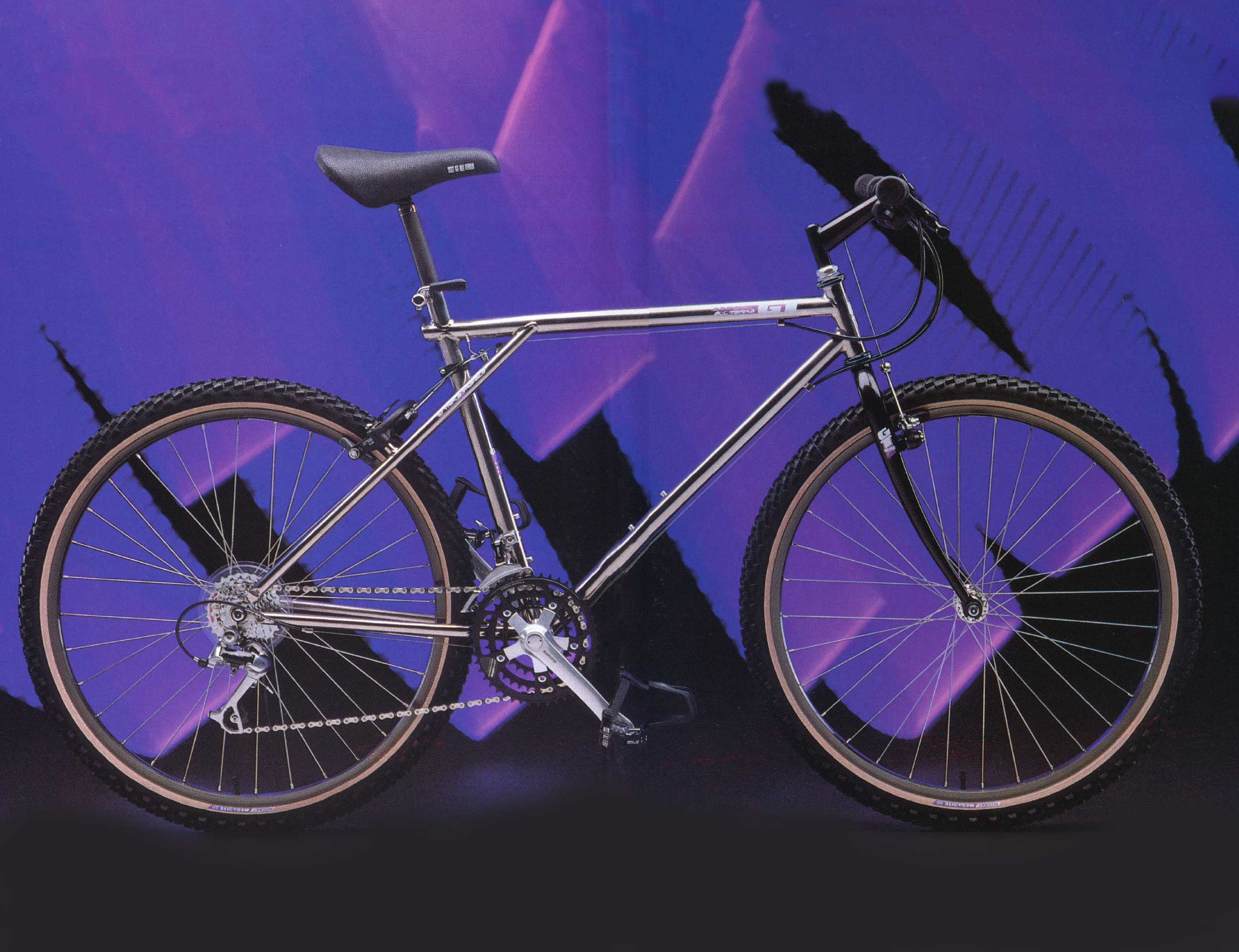
Titanium Xizang LE added to the range for 1990
1988: Mountain Bike Success
To compete with Cannondale’s direct distribution network, complete with sales representatives, the company, from 1991-96, began shifting from outside distributors, spending nearly $20 million in that period on a nationwide distribution chain for bicycles and parts. President and cofounder Long began a continuous personal promotion campaign, going to weekend bike races to meet customers, dealers, the trade press, and vendors, and total revenue for 1991 reached $61 million. The following year revenues climbed to $93 million.
1989: Expanding the Mountain Bike Line
1992: Huge proliferation of GT innovations such as the Groove Tube, Flip Flop stem and 2 x 4 forks are introduced.
1990: Innovation with Shimano Rapid Fire
The company was incorporated as GT Holdings, Inc in August 1993. Three months later, the GT management led a leveraged buyout (LBO) which allowed the company to post revenues of $123.8 million and a net income of $3 million even as the competition struggled with losses, with sales declining and the public losing interest in the BMX sport. Because of the struggle, Long and Turner sold a controlling interest to Bain Capital in 1993.
1993: RTS hits the market and GT becomes a leader in full suspension.
Also during November of that year, the company’s management led a leveraged buyout (LBO), purchasing the company for an undisclosed sum, and cofounder Turner departed from the management of the company, leaving Long alone at the helm. Though the leveraged buyout depressed net income, the company still remained in the black for the year, posting revenues of $123.8 million and a net income of $3 million. Competitor Huffy, meanwhile, posted a year-end 1993 loss of $4.9 million.
The company was incorporated as GT Holdings, Inc in August 1993. Three months later, the GT management led a leveraged buyout (LBO) which allowed the company to post revenues of $123.8 million and a net income of $3 million even as the competition struggled with losses, with sales declining and the public losing interest in the BMX sport. Because of the struggle, Long and Turner sold a controlling interest to Bain Capital in 1993.
1991: The Zaskar and Mountain Bike Expansion
1994: RTS becomes a complete line of suspension bikes.
1992: Full-Suspension Breakthrough with RTS
beckert, beverly. “mission possible!: first to market.”knight-ridder/tribune news, 17 july 1995.
In October 1995 GT Bicycles issued its common stock in an initial public offering at a price of $14.00 per share. GT Bicycles stock ranged from a low of $5.42 to a high of $10.37 during a 52-week period. The stock's price-earnings ratio is 19.53 and its earnings per share is $.32. The company has never paid a cash dividend and intends to retain its earnings for use in the business.
In the 1980s GT entered the mountain bike market, a market that was faster growing and pricier than the BMX market. From 1989 through 1994 company revenues increased from $41 to $146 million. In 1998, GT controlled a 40-percent plus share of the independent bicycle retailers’ juvenile BMX business. GT completed its initial public offering of stock on October 18, 1995, issuing 3.15 million new shares and receiving net proceeds of approximately $40.2 million, of which approximately $37.1 million was used to repay debt. GT established a rather impressive long term financial record.
1995: LTS ruled the MTB line up and GT is the first to supply dealers with a fully functional 4 bar linkage MTB made in the USA and damped by the infamous ALPS 5 by Fox.
The Karakoram won “1995 bike of the year”
The company offers profit sharing for all employees who have worked for the company at least 12 months. Also, in 1995 the company's ``Stock Purchase Plan`` was adopted by the Board of Directors, covering an aggregate of 300,000 shares of common stock. Employees are eligible to participate if they have been employed by the company for at least one year.
1993: Continuing Innovation and Early RTS Success
Product development remains a top priority for GT and the company is beginning to realize its goal of developing direct distribution in key international markets. While GT established an important presence in international markets, representing some 30 percent of 1996 revenue, the company perceives an important opportunity to improve the growth and profitability of these markets. Internally, GT is focusing on the implementation of process improvements in manufacturing and distribution functions, which will allow for greater manufacturing efficiencies. In order to quickly fill orders from bicycle dealers, the company’s wholly owned distributors maintain significant inventories. The company believes the close relationships with its principle manufacturing sources allow it to introduce innovative product designs and alter production in response to market demand for its product.
In 1996, GT won a commission to manufacture a $30,000 carbon fibre “Superbike” for the Summer Olympic games. The company has sponsored numerous race teams and racers including notable riders Rebecca Twigg, Bob Morales, Juli Furtado, and Eddie Fiola.
1994: Expanding Product Lines and Planning for IPO
sterngold, james. “bike makers try comfort and gizmos to pump up profit.” new york times, 30 november 1997.
In 1997, GT introduced 3 new carbon fiber high end LTS full susp.
1995: Preparing for the IPO and Focus on Racing Success
Also offered to the amazement of many is the IT-1….the commercialization of the original Gear Box design first shown in Anaheim in 1998.
Early in 1998, the company entered into negotiations with Questor Partners to be acquired. In July, under the aegis of Schwinn, Questor acquired all of the stock and debt of GT Bicycles for a price of approximately $180 million. Following the acquisition, Cannondale remained the last publicly traded bicycle company in the United Sates.
1996: A Year of Major Success and Challenges
1999: I-Drive is born and marks a new chapter in MTB suspension technology.
1997: Facing Market Challenges and Continued Innovation
2000: GT acquires the Syncros brand and gets into the Tour De France.
The LTS –2000 won “Bike of the Year” .
2000: ULTRABOX !!!. An all new creation by PM Robert Kahler and Industrial Designer Alec Tam blows away the BMX world.
1998: Sale to Questor Partners Fund and Merger with Schwinn
1998: Sale to Questor Partners Fund and Merger with Schwinn
2001: The new I-Drive Team (inspired by the bike Roland raced) weighs in at about 24.5 pounds and brings I-Drive onto the race courses of the world in numbers.
2001: In an effort to catch up to the rider owned companies GT switches the focus to the X Games crowd and starts to market their athletes more aggressively with an all new model line up.
On the 5th death anniversary of Richard Long in 2001, Questor filed for bankruptcy and was acquired by Pacific Cycle.